
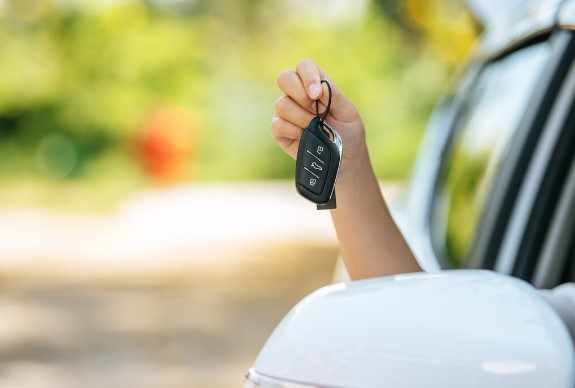
The word "fob" traces back to 17th-century Germany, long before cars existed, and entered the automotive world when car manufacturers needed a name for something small, handheld, and clipped to your keys.
That's the short answer. Here's the full story of how the word "fob key" came-
The Word "Fob" Is 400 Years Old
The name has nothing to do with technology. It starts with "fuppe," an old German word for a small, hidden pocket sewn into trousers where men stored their pocket watches. Over time, the decorative chain or charm dangling from that watch pocket also came to be called a "fob."
By the 1800s, English speakers were using "fob" to describe any small ornament attached to a keyring or watch chain. The word already meant: small, functional, attached to keys.
So, when carmakers started shipping remote entry devices in the early 1980s, they didn't need to invent a name. The industry borrowed a word that already fit perfectly. The fob key arrived quietly, through language, not a product launch.
When the Remote First Appeared on Cars
The 1983 Renault Fuego was the first production car to offer a factory keyless entry system. American automakers followed fast. By the mid-1980s, General Motors was offering remote entry on select Cadillac and Buick models.
Those early units were basic. Large, limited-range, single-frequency radio signals. The device was separate; you still used a cut metal key to start the ignition. The remote only handled locking and unlocking.
But that changed everything for the automotive car locksmith. Replacing a lost car key was no longer just a matter of cutting. It now requires frequency matching, knowledge of rolling codes, and programming capability. The trade got more complex, and the remote entry device became the job's most technical component.
What's Actually Inside a Fob?
Open one carefully, and you'll find:
Small PCB (printed circuit board)
CR2032 or similar lithium battery
Radio frequency transmitter (typically 315 MHz in North America)
Transponder chip in modern units; this is the part that communicates with the car's immobilizer system
The transponder chip is what makes modern fob key replacement a specialized job. It doesn't just send a signal; it exchanges encrypted rolling codes with the vehicle's ECU. Without the correct code, the engine won't start regardless of whether the key blade turns in the ignition.
This is precisely why a qualified automotive locksmith uses professional key-coding tools to program replacements. The tools read the vehicle's stored codes, write the new key data, and verify the pairing. Without proper programming software, the remote becomes an expensive paperweight.
Fob Key vs. Transponder Key vs. Smart Key: What's the Difference?

A fob key, in its traditional sense, is the standalone remote. A remote head key merges the blade and the remote into one piece; it is very common on American vehicles from the 2000s onward. A transponder key has no buttons; it just disarms the immobilizer when inserted. A smart key stays in your pocket and lets you press a button on the door handle or dash to enter and start.
Every single one of these requires a different approach. Remote head keys need both a key-cutting machine to shape the blade and key-coding tools to program the chip. Smart keys require advanced key coding tools that support proximity protocols. Transponder-only keys need chip cloning or ECU programming.
Understanding the difference tells you exactly what tools are needed before the job starts.
How an Automotive Car Locksmith Replaces a Key Fob Today
The process looks like this:
Step 1: Identify the correct device
Year, make, model, and trim level all determine the right part. The frequency, button count, chip type, and FCC ID must match exactly. Getting this wrong means the key codes don't communicate with the car.
Step 2: Cut the blade if needed
Most remote head keys and smart keys have an emergency metal blade. A calibrated key-cutting machine traces or decodes the original key profile and cuts a new blade to spec. A high-quality automated cutter matters here; an imprecise cut will jam the lock cylinder or prevent it from turning.
Step 3: Program the hardware
This is where proprietary devices earn their place. Depending on the vehicle, programming may use OBD-II port access, on-board sequences, or specialized technician software. Professional setups support thousands of vehicle configurations and eliminate the guesswork.
Step 4: Test every function
Lock, unlock, trunk release, panic alarm, and remote start (if applicable). Every button gets verified before the job is done.
Fob Key in 2026: What's Changing
The industry is moving fast. Ultra-wideband tech is popping up; it measures exactly how close you are to your car to block relay attacks (basically, fancy thieves can't trick your car into unlocking). Digital keys on smartphones are now standard in new models, and biometric entry is just around the corner. But with hundreds of millions of regular units still out there, locksmiths will always have plenty of work. The tech's not making these jobs disappear; if anything, it's making the work more specialized.
Lock in Your Competitive Edge with Transponder Island
From 17th-century pocket charms to high-tech proximity smart keys, the "fob" has come a long way. But today, keeping drivers on the road takes more than history; it takes cutting-edge precision. Behind every seamless replacement is a skilled locksmith armed with top-tier machinery and advanced programming tools.
Don't let subpar parts stall your business or cause costly callbacks. Stock your shop with the industry's best- Transponder Island, for premium wholesale fob key inventory, elite diagnostic tools, and unbeatable reliability.
Explore Transponder Island now!

Write a comment ...